




Spiders of Kyrgyzstan
Newsletter no. 116.pdf
On December 29, 2025 the Ministry of Digital Development and
Innovative Technologies of the Kyrgyz Republic puts into circulation a series of Kyrgyz Express Post postage
stamps: "Spiders of Kyrgyzstan".
Spiders are the central order of the subphylum Chelicerata within
the phylum of arthropods. They are widespread across the globe, including in Kyrgyzstan, inhabiting
environments ranging from sandy deserts, caves, and lakes to forest canopies and rocky moraines near
glaciers. The vast majority of spiders are active predators, hunting primarily invertebrates and using a
system of external digestion. Many spiders catch their prey using sticky webs, while other types of silk are
used for passive aerial dispersal.
Around 650 spider species from 28 families inhabit the territory of
the Kyrgyz Republic. The new issue of KEP stamps is dedicated to three spider species occurring in
Kyrgyzstan.
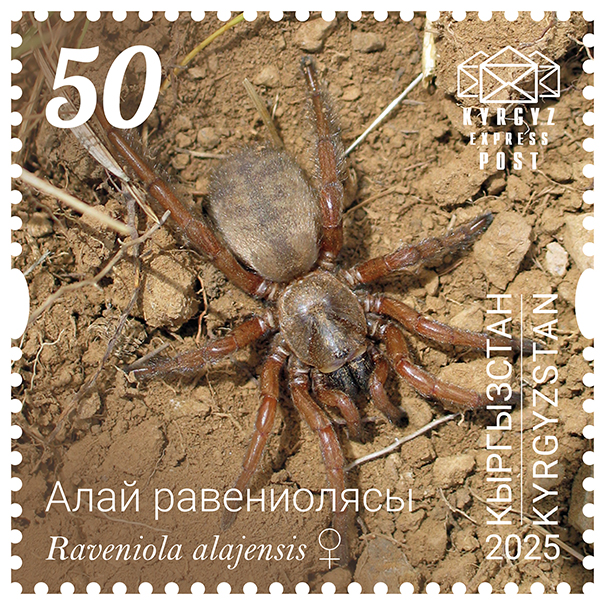
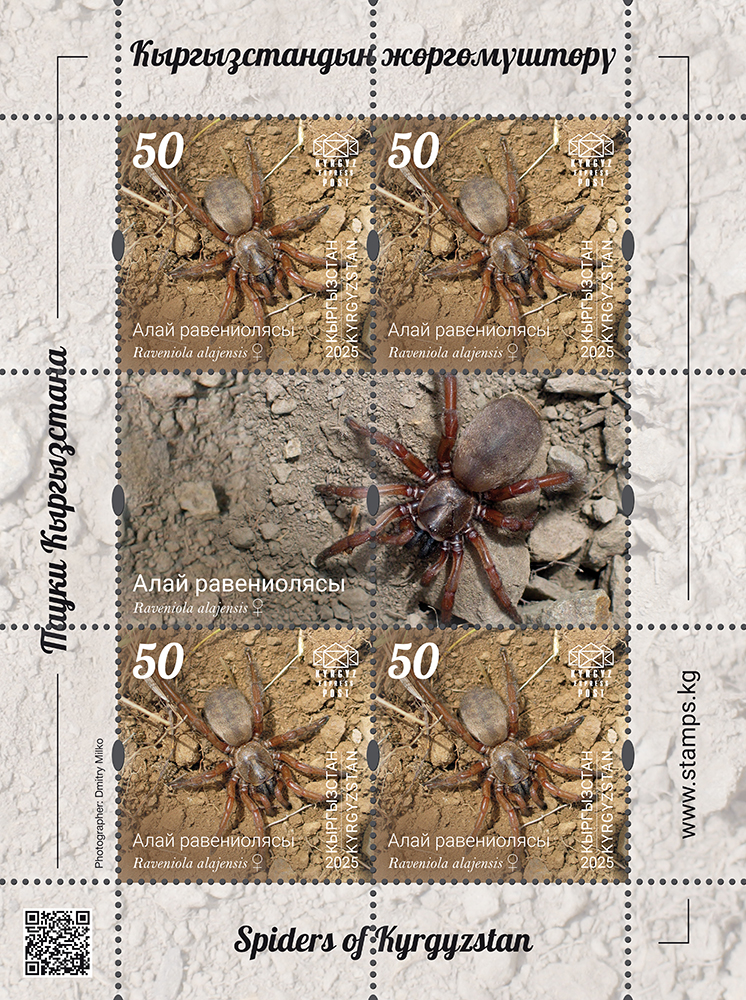
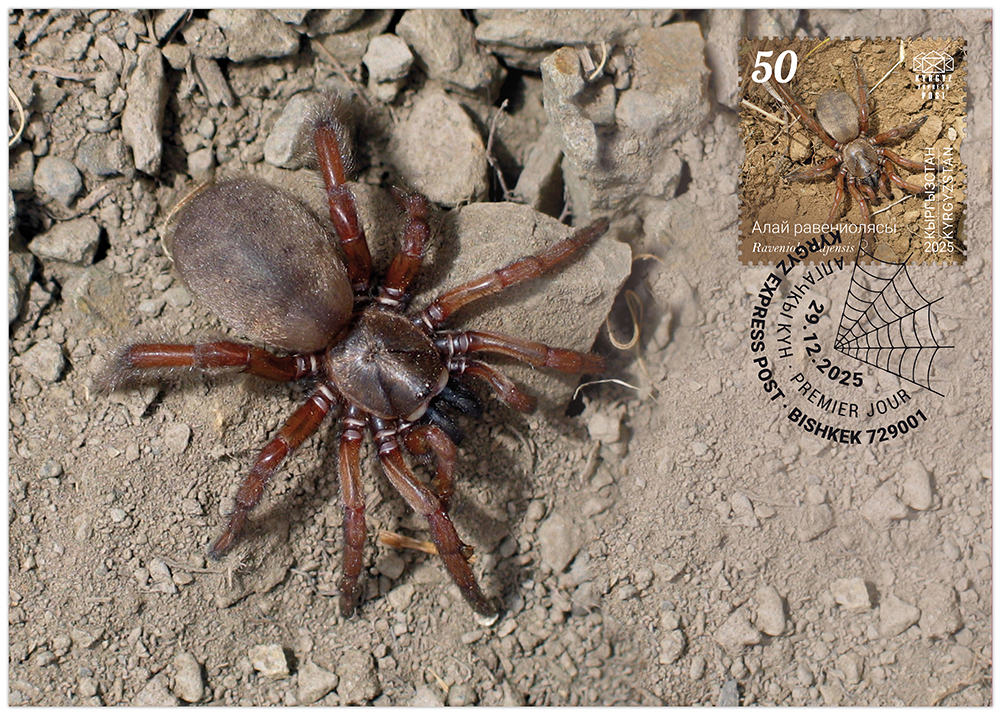
The Alay trapdoor spider (Raveniola alajensis) – a
rare
representative of the Nemesiidae family, which is closely related to tarantulas (suborder Mygalomorphae).
This species was officially described in 2023. Its narrow relict range covers the western part of the Alay
Valley and the gorges of the tributaries of the Kyzyl-Suu (Vakhsh) River in neighboring Tajikistan. This
spider digs a burrow where it lives for many years, and during winter or unfavorable conditions, it closes
the entrance with a “trapdoor,” making its dwelling extremely difficult to spot.
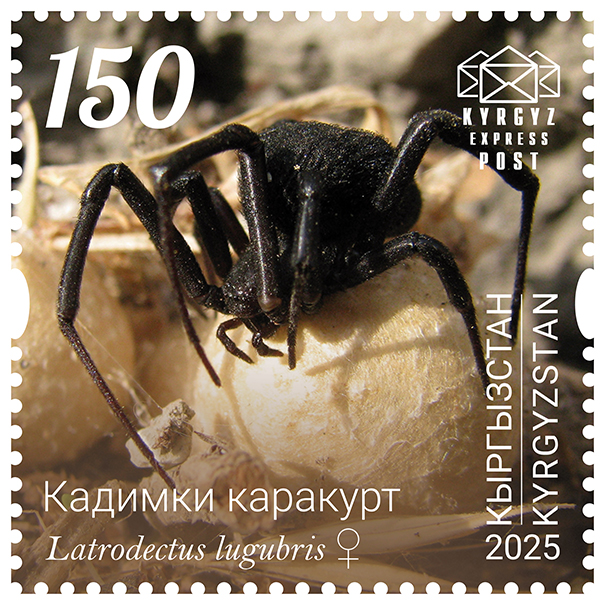
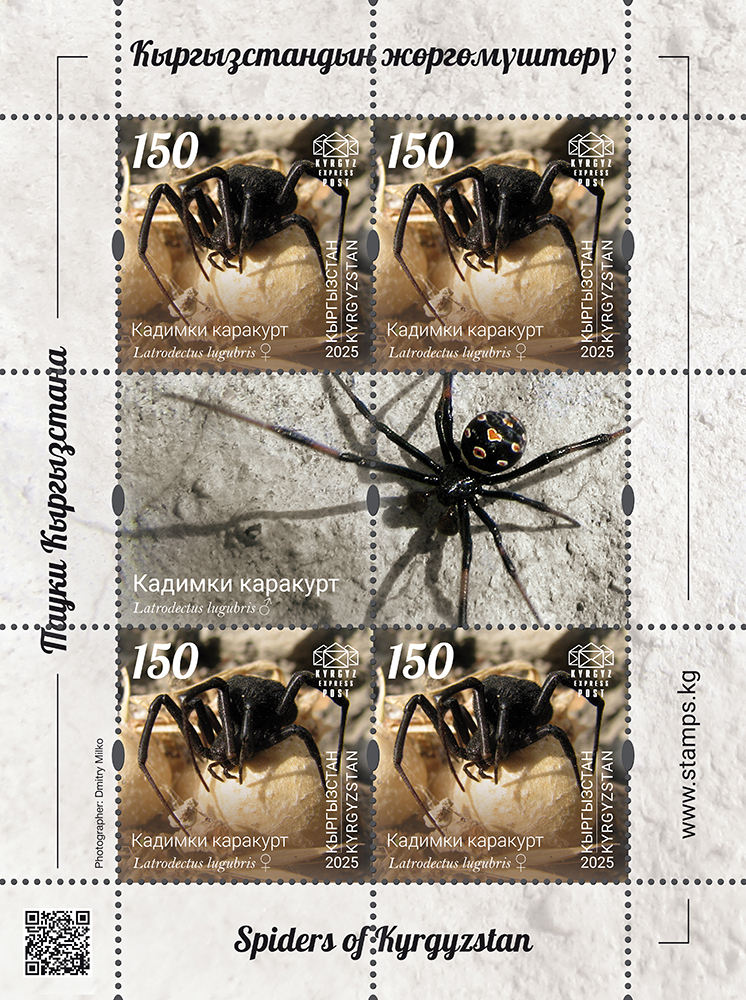
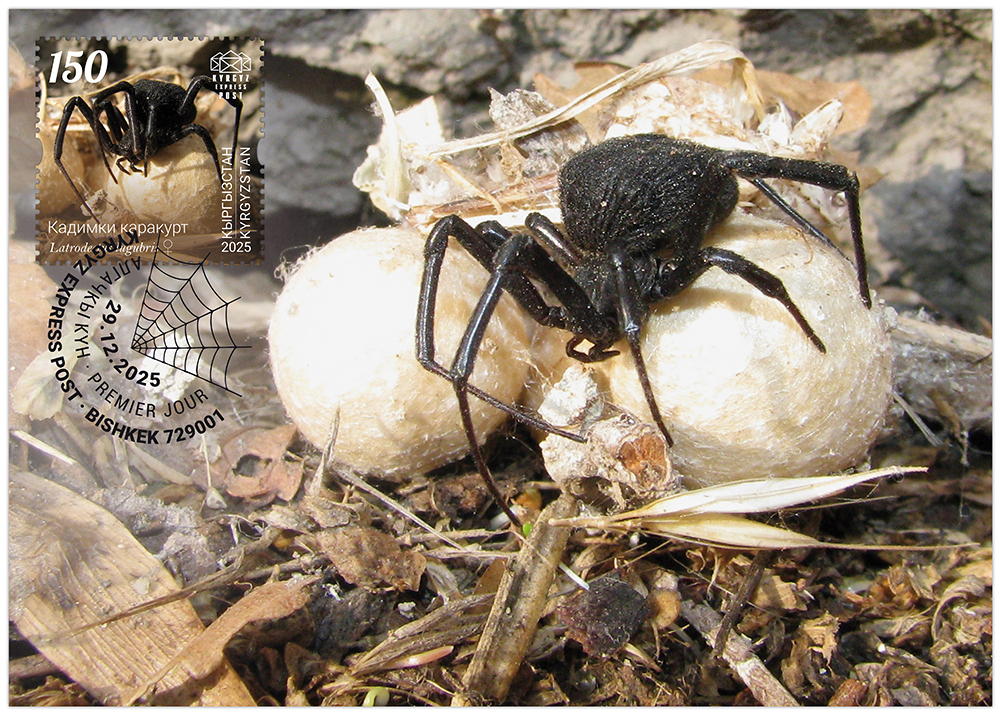
The Asian sorrowful black widow (Latrodectus
lugubris) – a
representative of the Cobweb spider family Theridiidae. Black widows (species of the genus Latrodectus) are
widely known for their sexual dimorphism and potent venom. This species is distinguished from its European
counterparts by the completely velvety-black coloration of the adult female, and is distributed in warm and
arid regions of Middle Asia and Southern Kazakhstan, occurring almost everywhere in semi-desert and steppe
biotopes in Kyrgyzstan. The Asian sorrowful black widow’s venom possesses a strong neurotoxic effect.
However, with timely medical assistance, a bite does not pose a threat to human life. Despite their ominous
reputation, these spiders lead a cryptic lifestyle and rarely exhibit aggression.
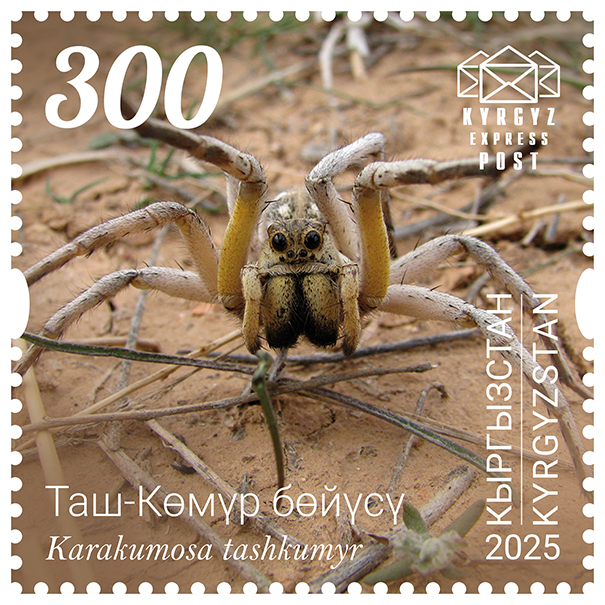
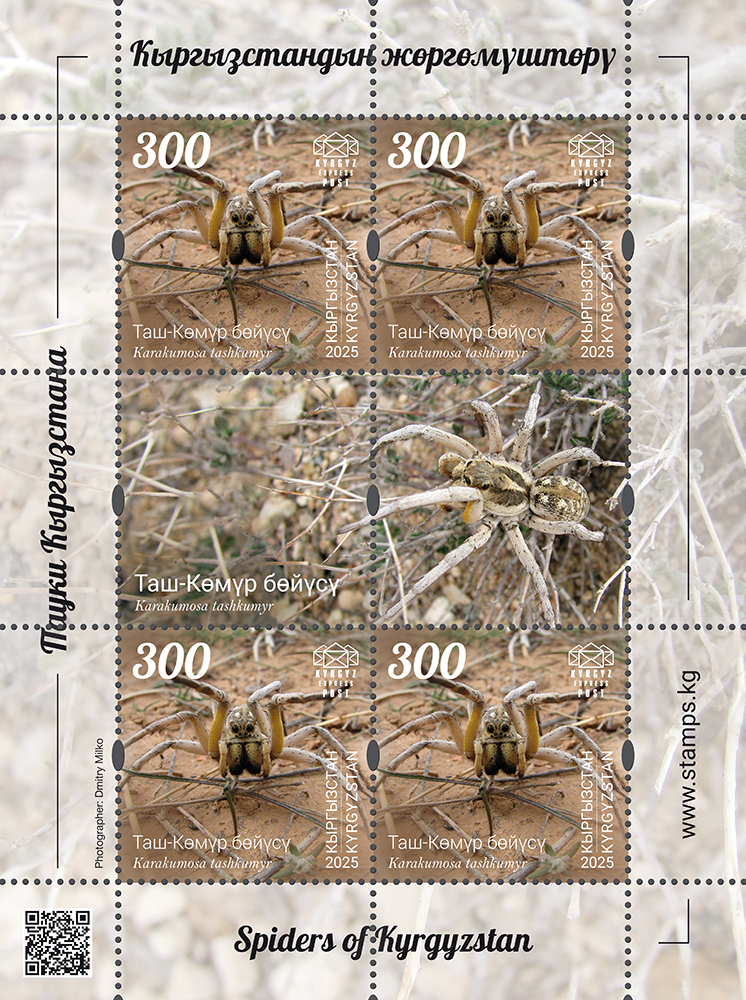
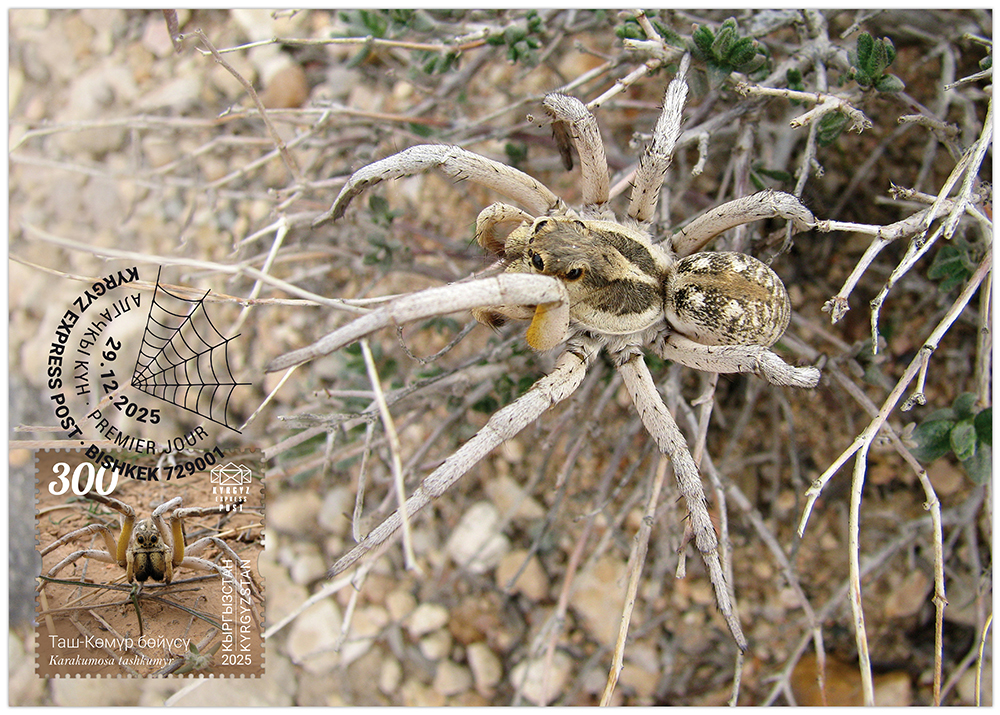
The Tash-Kumyr tarantula wolf spider (Karakumosa
tashkumyr) – a
large representative of the Wolf spider family Lycosidae. The species was officially described in 2020 and
is currently considered endemic to the Cis-Ferganian Kyrgyzstan. Wolf spiders do not build capture webs,
they actively hunt on the ground, tracking prey thanks to their excellent nocturnal vision, and surviving
the daytime heat in deep burrows. Female Wolf spiders show care for their offspring.
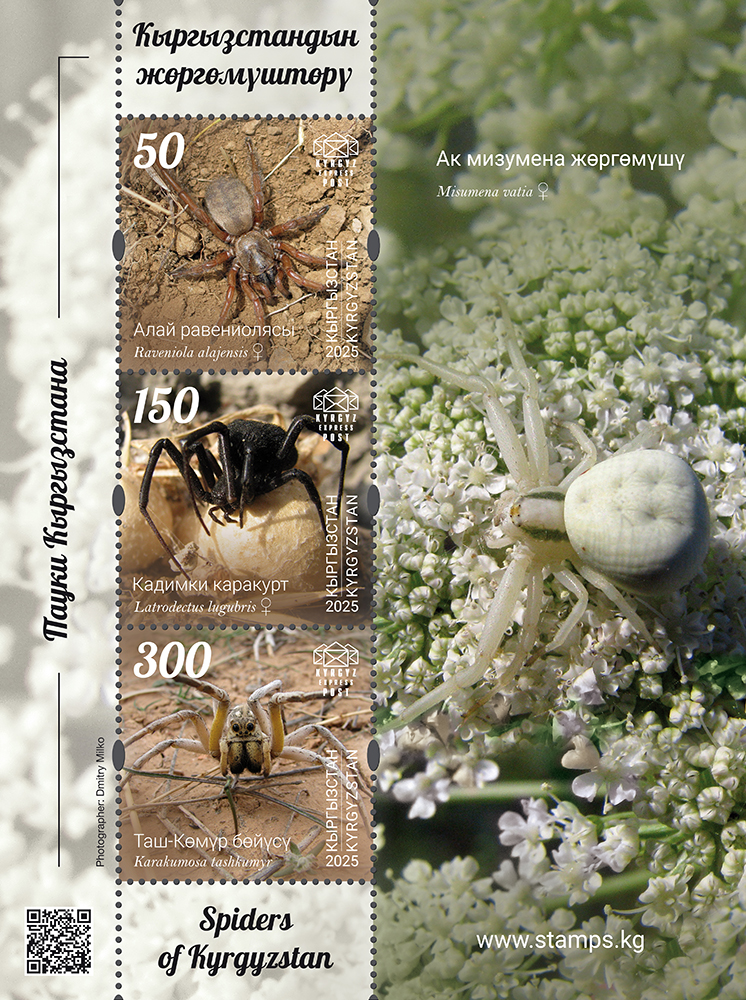
The margin of the collective minisheet features the Goldenrod
crab-spider (Misumena vatia) – a representative of the Crab-spider family Thomisidae. This
species is
widespread almost everywhere in Eurasia and North America and is known for the wide range of its bright
coloration, which camouflages the ambush predator on various flowers and inflorescences. The First Day Cover
of the series features the male Ladybird Spider (Eresus kollari), a member of the Velvet
spider family
Eresidae. This species sporadically inhabits warm regions of western Eurasia and is notable for its
pronounced sexual dimorphism and exceptionally sedentary lifestyle.
KEP expresses sincere gratitude to entomologist Dmitry Milko,
Senior Researcher at the Institute of Biology of the National Academy of Sciences of the Kyrgyz Republic,
for his valuable consultation and for providing photographs used in preparing this issue.
Spiders play an important role in the biodiversity of Kyrgyzstan.
They play a crucial ecological role by regulating populations of insects and other small animals, forming an
integral part of all terrestrial ecosystems. The KEP stamp issue aims to draw attention to these remarkable
creatures and to emphasize the importance of preserving Kyrgyzstan’s unique natural heritage.
For this series, KEP also issues three postcards, which are used to
realize three maximum cards.
Stamps description
No. 259. 50 KGS. The Alay trapdoor spider (Raveniola alajensis)No. 260. 150 KGS. The Asian sorrowful black widow (Latrodectus lugubris)
No. 261. 300 KGS. The Tash-Kumyr tarantula wolf spider (Karakumosa tashkumyr)
Technical specifications
Paper: coated, gummed, 105 g/m².Printing method: full-color offset lithography.
Stamps perforation: comb 13 syncopated.
Stamps size: 34 × 34 mm.
Stamps are issued in minisheets of 4 stamps with
two labels. Stamps are also issued in a collective
minisheet of three stamps (one complete set)
Goldenrod crab-spider (Misumena vatia) is represented on the margins of the collective minisheet.
Minisheets size: 100 × 134 mm.
Collective minisheet size: 100 × 134 mm.
Quantity issued: 7 500 pieces each stamp
(5 000 in minisheets plus 2 500 in collective minisheets).
Photographer: Dmitry Milko.
Designer: Daria Maier.
Printer House: "Nova Imprim" (Chișinău, Moldova).
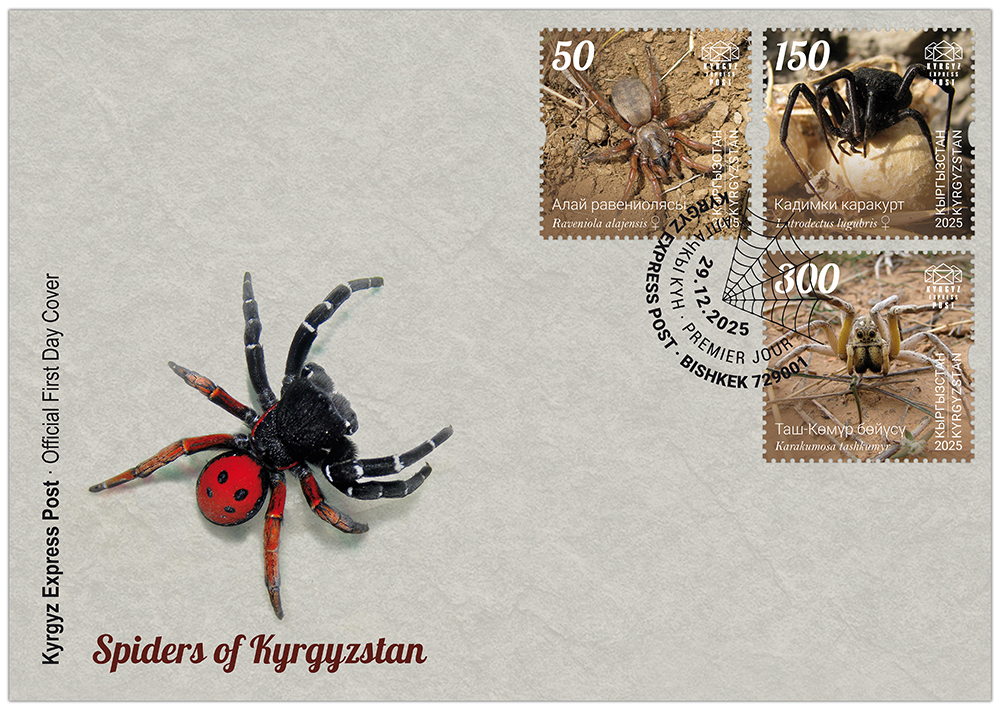
A special cancellation on FDC will be carried out at the Bishkek KEP Office (729001) on the stamps issuing day.
The first day cover, postcards and special
postmark are designed by Daria Maier.
Photographer: Dmitry Milko.
Cover size: С6 (162 × 114 mm).
Quantity of covers issued: 400 pieces.
Quantity of postcards issued: 400 pieces each.
Endorsing ink color: black.
Stamps, maximum cards and FDCs can be purchased here.