



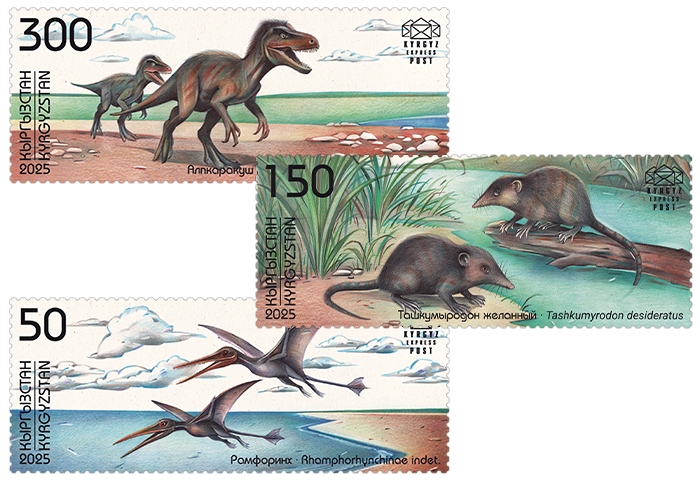
Prehistoric Fauna of Kyrgyzstan
Newsletter no. 121.pdf
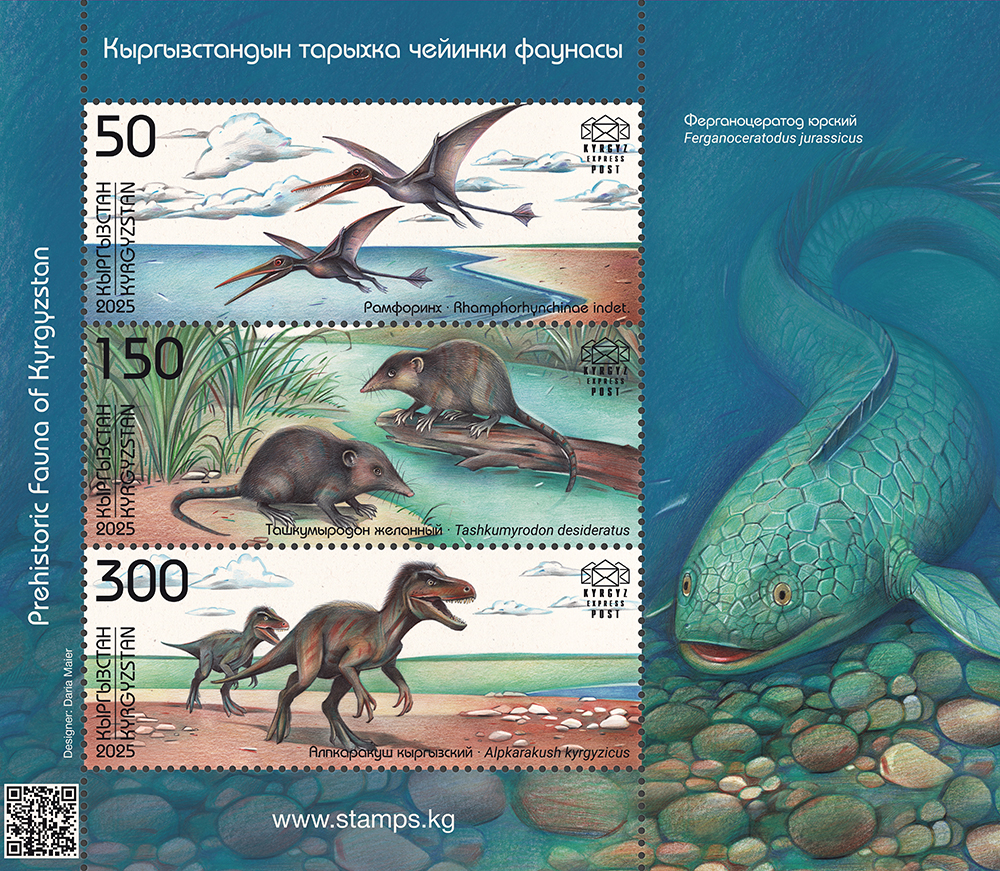
On December 29, 2025 the Ministry of Digital Development and Innovative
Technologies of the Kyrgyz Republic puts into circulation a series of Kyrgyz Express Post postage stamps:
"Prehistoric Fauna of Kyrgyzstan (continuation of the series)".
Millions of years ago, the territory of modern Kyrgyzstan was home to
remarkable creatures, whose remains today help paleontologists reconstruct the picture of the region's
distant past. Unique fossils were discovered in the deposits of the Jurassic and Cretaceous periods,
reflecting the richness and diversity of the region’s ancient fauna. The new issue of KEP stamps continues
the theme of prehistoric animals and features three rare species whose remains were discovered specifically
in Kyrgyzstan.
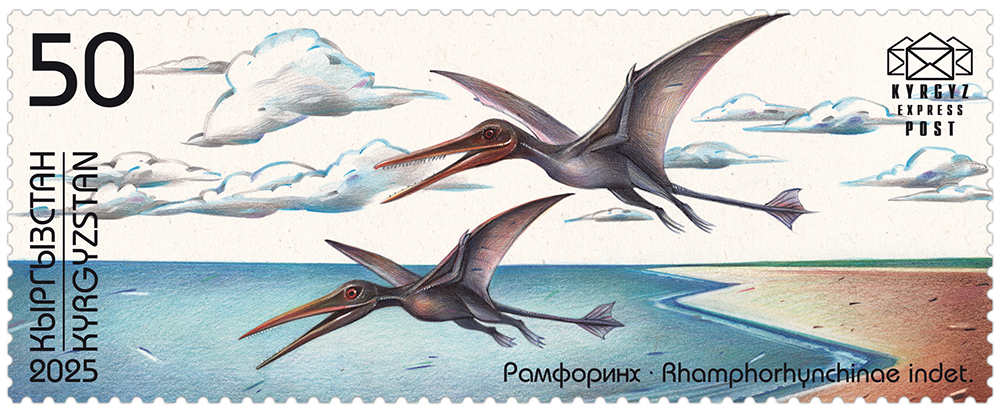
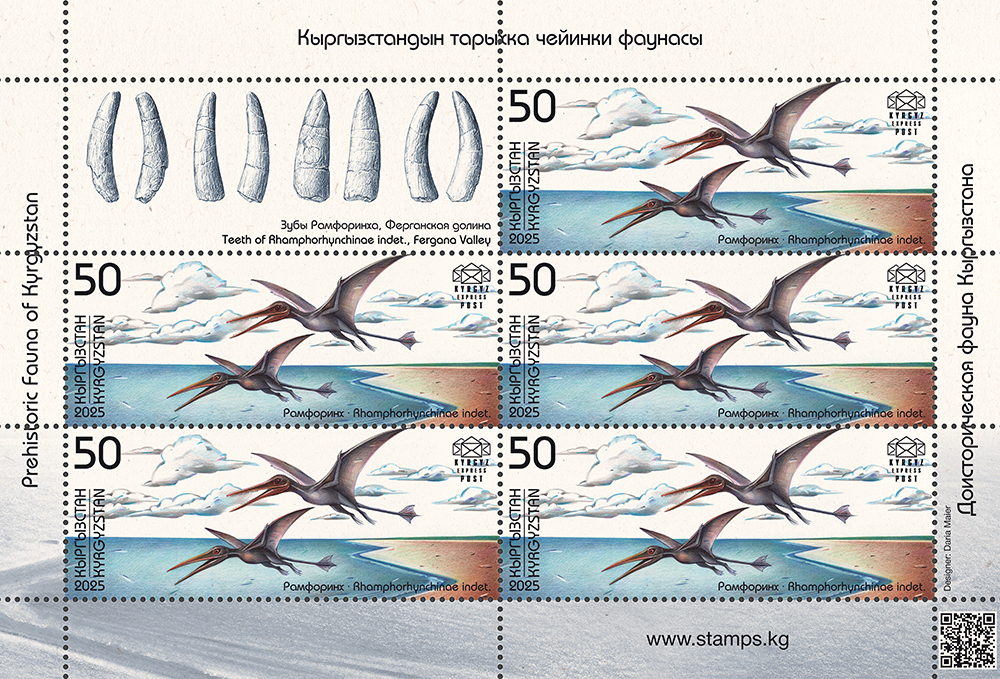
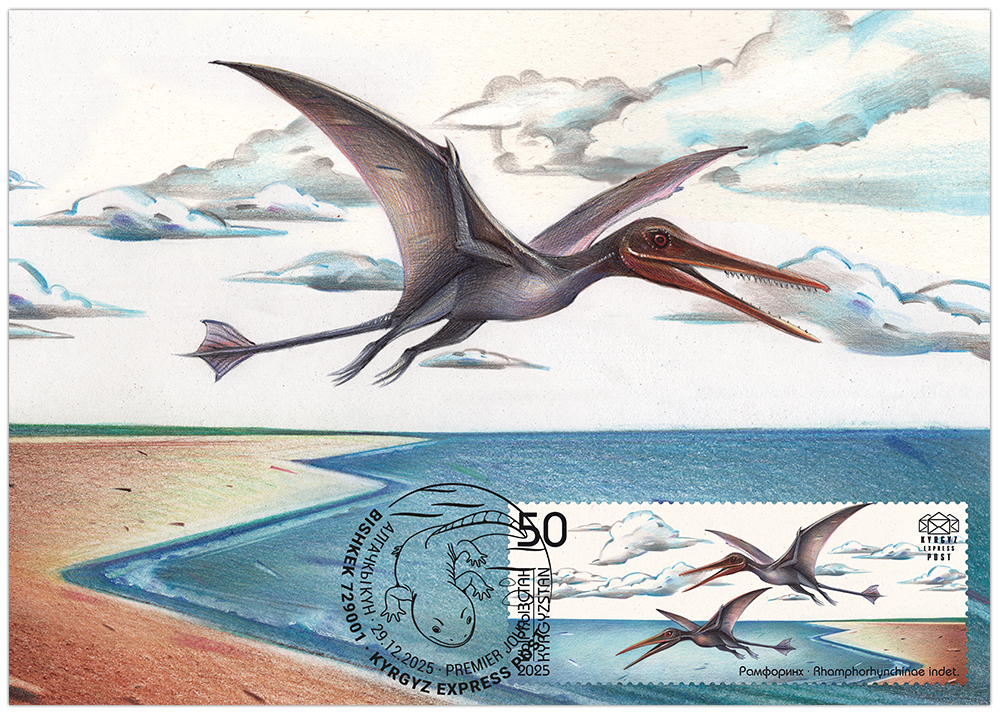
Rhamphorhynchine (Rhamphorhynchinae indet.) – a
representative of the order Pterosauria that lived approximately 160-145 million years ago. These ancient
flying reptiles were distinguished by a long tail ending in a diamond-shaped vane, which helped stabilize
their flight. Rhamphorhynchines hunted fish and small animals, inhabiting areas near water bodies.
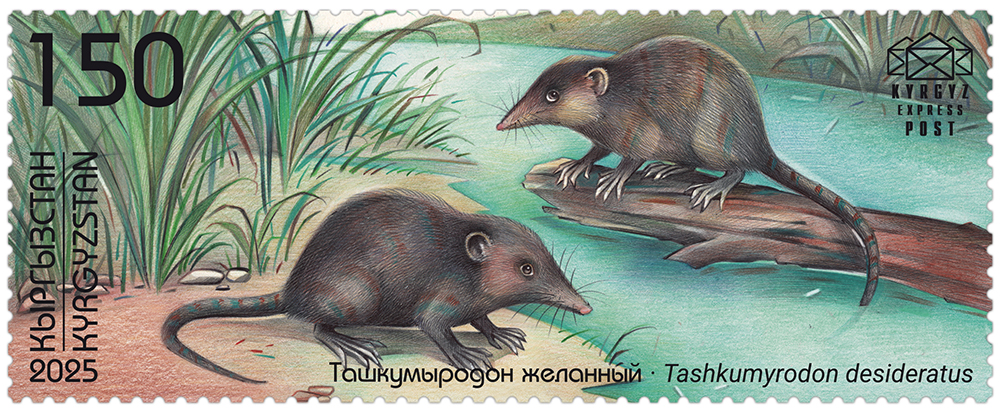
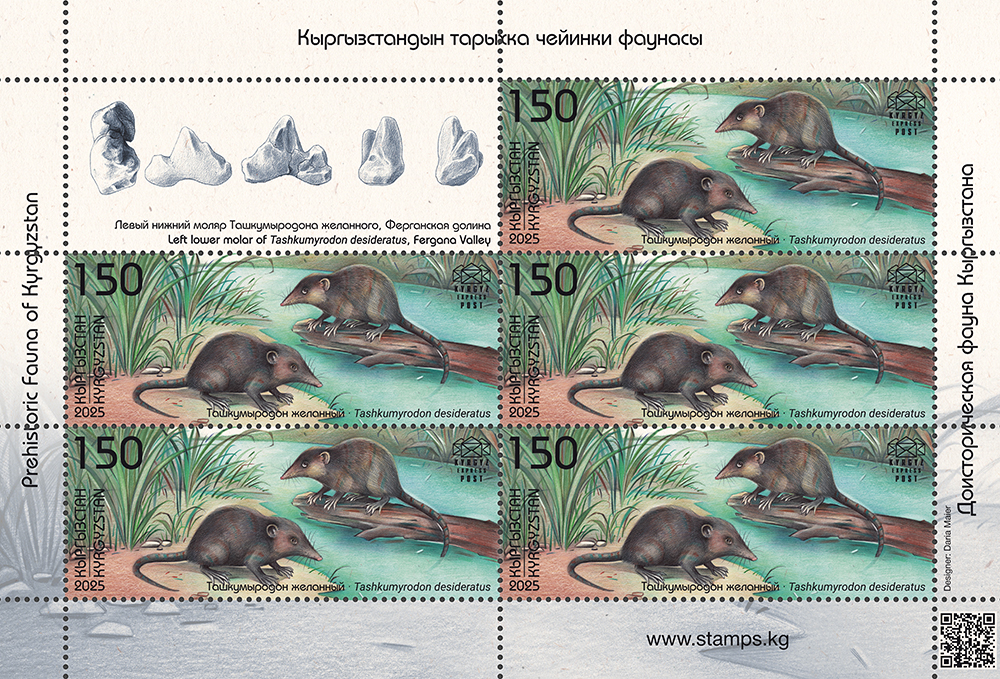
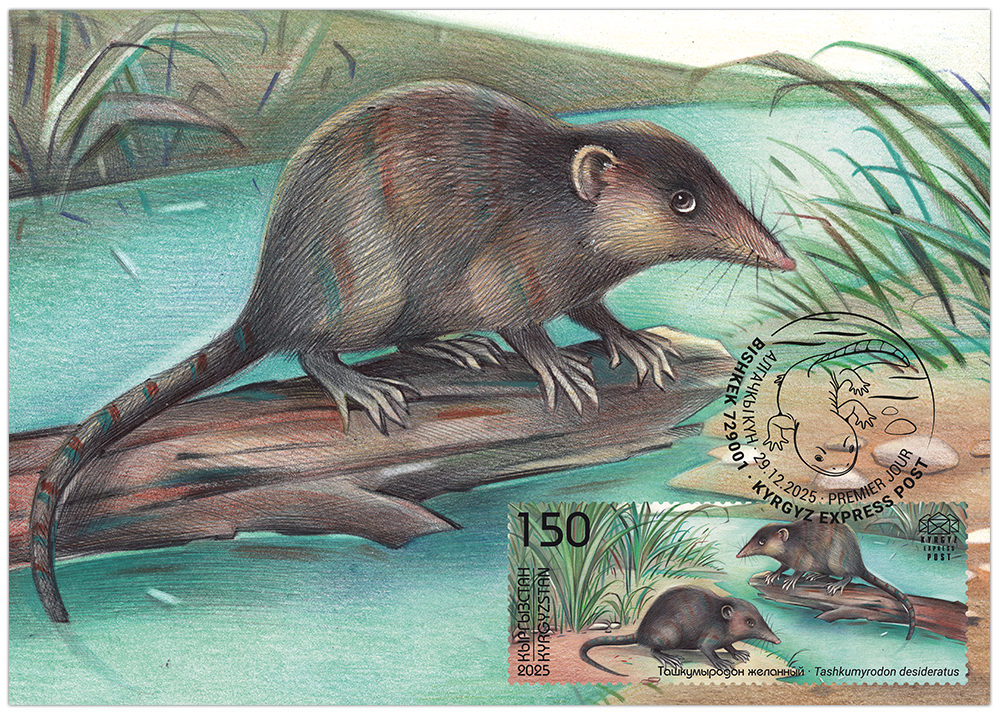
Tashkumyrodon desideratus – one of the earliest known
mammals in Asia. It lived approximately 163 million years ago in the area of modern Tash-Kumyr.
Tashkumyrodon was comparable in size to a small mouse, fed on insects and led a nocturnal lifestyle. Its
discovery is an important contribution to the study of early mammalian evolution.
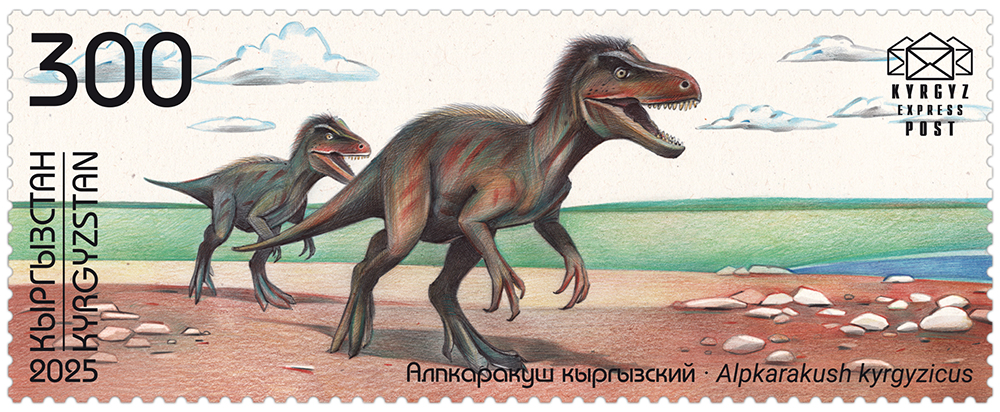
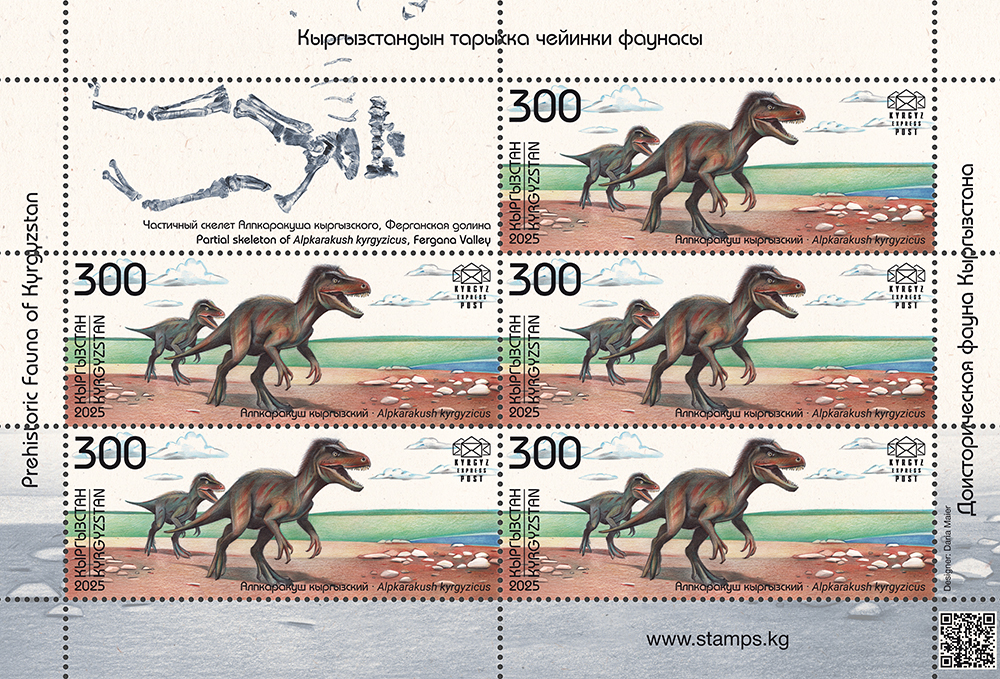
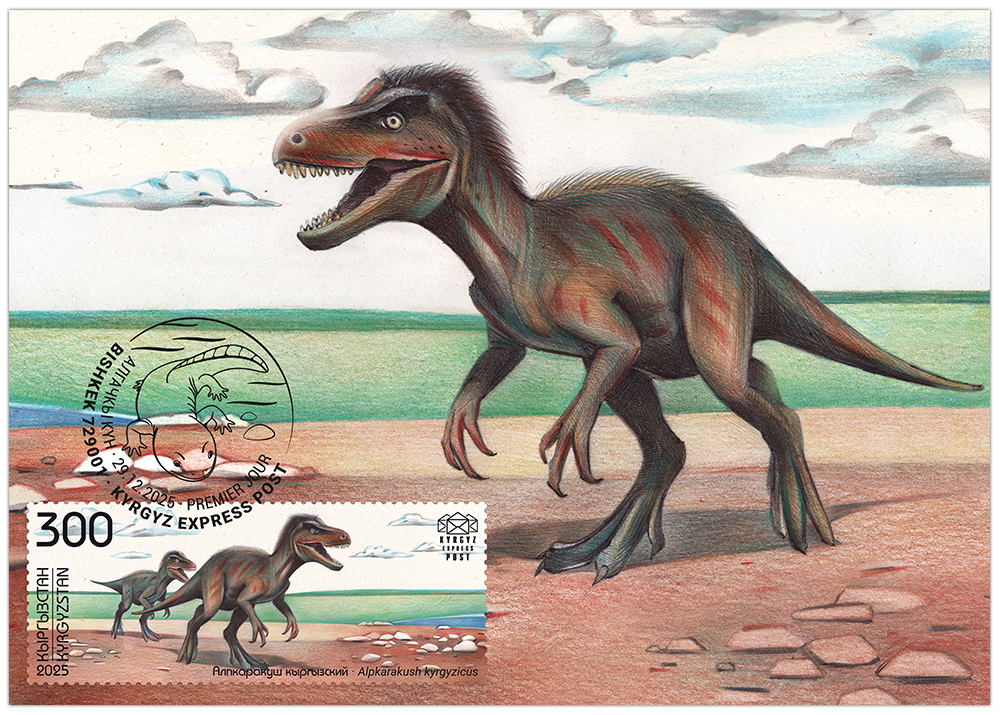
Alpkarakush kyrgyzicus – a predatory theropod dinosaur
that lived approximately 163 million years ago. Its remains were found in the Balabansai Formation in the
Tash-Kumyr region. Alpkarakush was a terrestrial predator with a well-developed skeleton and powerful hind
limbs. The discovered bones indicate a typical theropod body structure and predatory behavior. The discovery
of this fossil is significant for Central Asian paleontology, as it expands the understanding of Jurassic
fauna diversity in the region and sheds light on the evolutionary connections of theropods with other groups
of predatory dinosaurs.
The margins of the collective minisheet feature Ferganoceratodus
jurassicus – a genus of lungfish (Dipnoi) whose remains were discovered in the Jurassic
deposits in Kyrgyzstan. Lungfish are known for their unique ability to use their swim bladder as a primitive
lung for breathing atmospheric air. Thus, these fish possessed both gill and pulmonary respiration.
KEP expresses its sincere gratitude to Aizek Asanbekovich Bakirov, Acting
Director of the M. M. Adyshev Institute of Geology of the National Academy of Sciences under the President
of the Kyrgyz Republic, for his invaluable consultative assistance in preparing this issue of postage
stamps.
For this series, KEP also issues three postcards, which are used to
realize three maximum cards.
Stamps description
No. 271. 50 KGS. Rhamphorhynchine (Rhamphorhynchinae indet.)No. 272. 150 KGS. Tashkumyrodon desideratus
No. 273. 300 KGS. Alpkarakush kyrgyzicus
Technical specifications
Paper: coated, gummed, 105 g/m².Printing method: full-color offset lithography.
Stamps perforation: comb 14:14½.
Stamps size: 69.00 × 27.50 mm.
Stamps are issued in minisheets of 5 stamps
with one label. Stamps are also issued in
a collective minisheet of 3 stamps (one complete set).
Ferganoceratodus jurassicus is represented
on the margins of the collective minisheet.
Minisheets size: 159 × 108 mm.
Collective minisheet size: 124 × 80 mm.
Quantity issued: 7 500 pieces each stamp (5 000 in
minisheets plus 2 500 in collective minisheets)
Designer: Daria Maier.
Printer House: "Nova Imprim" (Chișinău, Moldova).
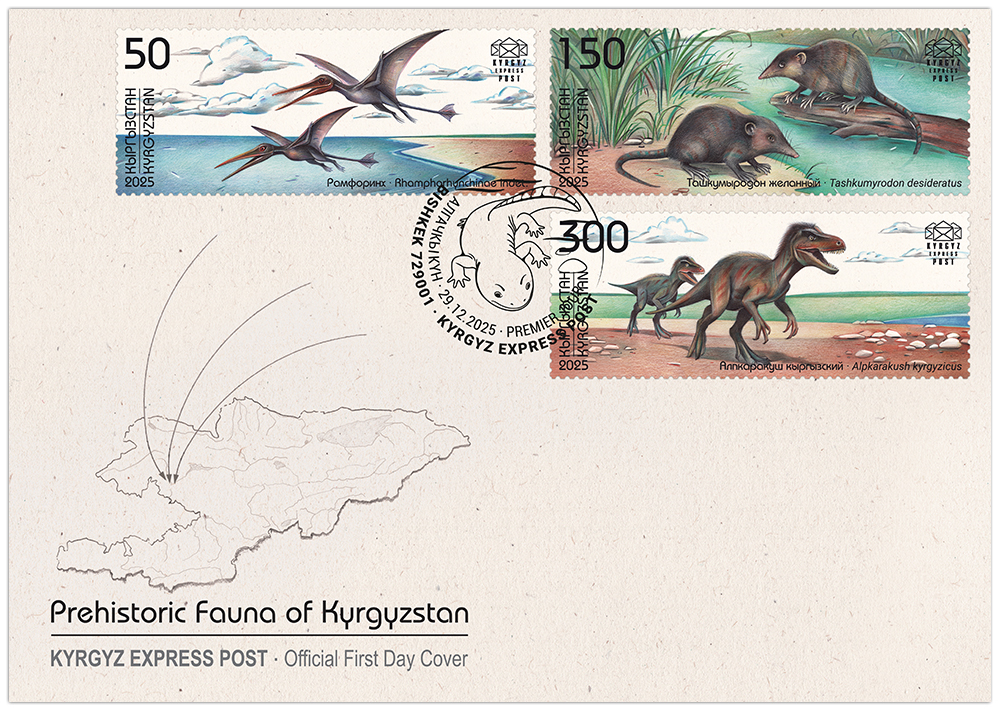
A special cancellation on FDC will be carried out at the Bishkek KEP Office (729001) on the stamps issuing day. The first day cover features the map of Kyrgyzstan with arrows indicating the locations where fossils of the respective dinosaurs depicted on the stamps were discovered.
The first day cover, postcards and special
postmark are designed by Daria Maier
Cover size: С6 (162 × 114 mm).
Quantity of covers issued: 400 pieces.
Quantity of postcards issued: 400 pieces each.
Endorsing ink color: black.
Stamps, maximum cards and FDCs can be purchased here.